The Most Well Known Doors In The World | Organized By TSTC
Throughout the ages, appeared a lot of famous buildings in the world, some of which assembled also the world famous doors /gates, left behind a special heritage to the people, the part below are some of them .
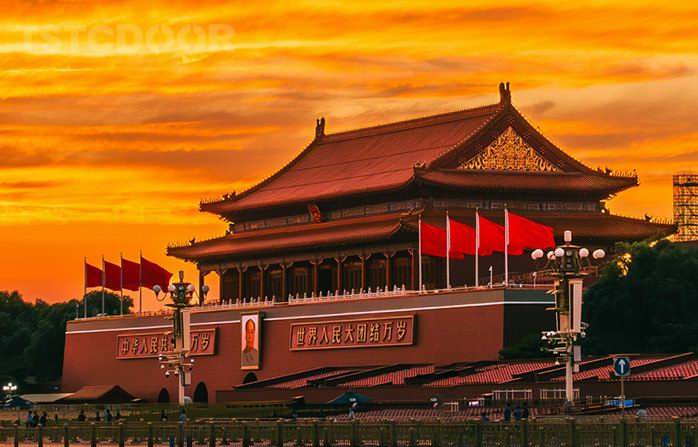
1. Tiananmen (Gate of Heavenly Peace)-Beijing
At the northern end of Tiananmen Square, this was the principal gate of the Imperial City and the ceremonial approach to the Forbidden City. It was first built in 1417 under the Ming dynasty as Chengtianmen, the "Gate of Heavenly Succession," and rebuilt in 1651 under its present name. The structure measures roughly 66m long, 37m wide and 32m high, with a red stone terrace pierced by five passages and crowned by a double-eaved timber pavilion with yellow glazed tiles, flanked by paired stone lions and huabiao columns. It remains the gate most closely identified with the Chinese state.
2. Ruins of St. Paul's-Macau
On a hill in the old quarter of Macau stands what is left of the Church of St. Paul , a Jesuit church begun in 1602 and completed in 1637, then one of the largest Christian churches in Asia. A fire in 1835 destroyed the building and left only its granite facade: a five-bay stone screen with a triangular pediment, mixing Baroque ornament with Eastern motifs, including Chinese inscriptions and a dragon carved near the base. Since 2005 it has formed part of the UNESCO-listed Historic Centre of Macau, and it now functions as the city's most recognisable symbol - an entrance with no building behind it.
3. Brandenburg Gate-Berlin
Completed in 1791, the Brandenburg Gate was designed by Carl Gotthard Langhans for King Frederick William II of Prussia and modelled on the Propylaea, the monumental gateway to the Acropolis of Athens. It stands about 26 m high and 65.5 m wide, with twelve Doric columns creating five passages - the central one once reserved for royalty. The Quadriga, a four-horse chariot driven by the goddess of victory, was added on top in 1793. Once a city gate, later a symbol of division during the Cold War and now Berlin's foremost landmark, it has spent two centuries defining what a gateway can mean.
4. The Arc de Triomphe -Paris
Commissioned by Napoleon in 1806 and completed in 1836, the Arc de Triomphe occupies the centre of the Place Charles de Gaulle, from which twelve avenues radiate across the city. It measures 50 m in height, 45 m in width and 22 m in depth, and its faces carry reliefs together with the names of generals and battles of the Revolutionary and Napoleonic wars. Beneath the arch lies the Tomb of the Unknown Soldier, installed in 1921, with an eternal flame lit two years later. From its terrace, the view runs straight down the Champs-Élysées- the arch serving, as triumphal arches always have, as the threshold to the city.
5. Mövenpick Ibn Battuta Gate Hotel-Dubai
Beside Ibn Battuta Mall in Dubai, this five-star hotel is built around a monumental gate standing more than 60m high -an entrance conceived as architecture in its own right rather than a way in. The complex, opened in 2010, takes its name from Ibn Battuta, the 14th-century Moroccan traveller whose journeys shaped the interior themes and the 396 rooms and suites. Behind the gate, a 90metre lobby and a soaring atrium connect the hotel to the adjacent mall. It is a rare modern building whose entire identity is carried by its doorway.
6. Sungnyemun (Namdaemun)-Seoul
Sungnyemun -better known as Namdaemun, the Great South Gate is the largest surviving gate of the Joseon-dynasty wall that once encircled Seoul, and is designated National Treasure No. 1. First built between 1396 and 1398 and rebuilt in 1447, it consists of a massive stone base pierced by a single arched passage, topped by a two-storey timber pavilion with prominent bracket sets and tiled roofs. An arson fire in 2008 destroyed the wooden structure, after a five-year restoration it reopened in 2013. For centuries the ceremonial southern entrance to the capital, it now sits at the edge of one of Seoul's busiest market districts.
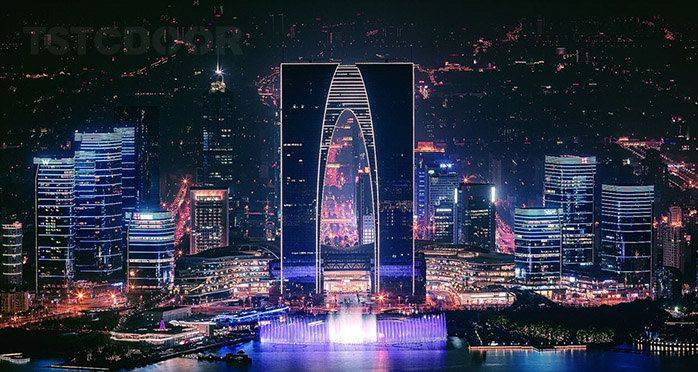
7. The Gate of the Orient-Suzhou
Rising 301.8 m above the west bank of Jinji Lake in Suzhou, the Gate of the Orient is a 68-storey building shaped like an immense doorway: two curved towers leaning inward, joined at the top by a bridging span. Designed by the British practice RMJM and completed in 2016, it takes its silhouette from Suzhou's historic water-and-land city gates, translating a classical form into a contemporary supertall structure. The result is a 300-metre arch that reads as a symbolic entrance to the city -a gesture of arrival on an architectural scale.
We TSTC will continue making great efforts to produce the best doors, and make one or more doors to be the world famous ones in the near future .


Comments
Post a Comment