Automatic Doors and Our Everyday Life |TSTC
How many doors do we pass through in a single day?
We arrive at the office tower and step through its revolving door. At lunch, a supermarket entrance slides open before we even reach it. In the evening, we squeeze out of a side door in your building's lobby with an armful of parcels. Late at night, we walk your family member through several glass doors at the hospital and finally stop outside one that does not open easily.
We rarely notice these doors. They are too smooth , so smooth they almost disappear. And that "invisibility" is the most remarkable thing about the automatic door industry.
1. Revolving Doors -The First Breath of a Lobby
At half past eight, a building's revolving door enters the busiest moment of its day. The glass compartments rotate one after another, each just wide enough for one person or one person with a laptop bag in one hand and a coffee in the other.
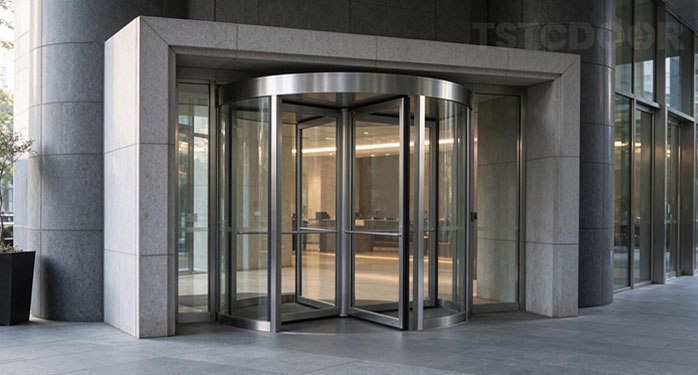
Revolving doors are often mistaken for a symbol of prestige. In fact, they are a machine for handling people: the enclosures between the wings keep the lobby sealed, so that in winter the space is not flooded with icy street air, and in summer the air conditioning does not escape through an open threshold. In a tower with hundreds of people entering every morning, replacing the revolving door with two wide swing doors would turn the lobby into a wind tunnel that no HVAC system could keep up with.
For the people who work there, the real meaning of the revolving door is "that single step". Outside is traffic noise, exhaust fumes, and hurry. Inside is quiet, steady temperature, and order. In the second we pass through, we unconsciously straighten your tie, put away your phone, and adjust your face into its "at work" expression. The door does not remind we - it does it for you.
2. Sliding Doors - Freeing Your Hands for What Matters
Supermarket entrances, metro stations, airports, outpatient halls - these places use sensor-activated sliding doors. Their value lies not in sophistication, but in the fact that they know we are coming.
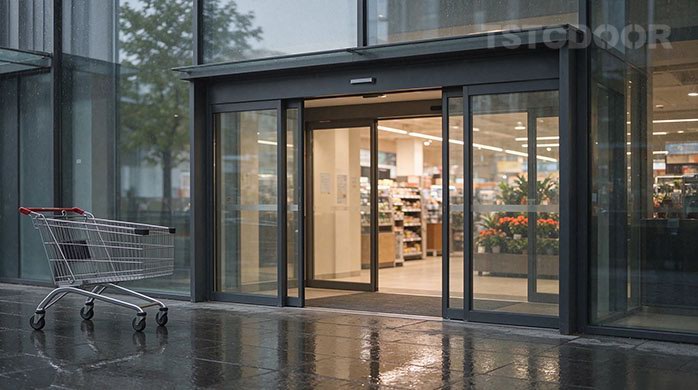
Push a shopping cart and both hands are on the cart. Carry a child and both hands are on the child. Pull a suitcase, hold a crutch, sit in a wheelchair , we simply do not have a third hand for the door. The sensor opens it for you. The door starts to slide before we arrive and closes only after we are through.
This is what accessibility looks like in daily life. It is not written into a standard and it is not printed on a notice. It simply means we do not have to shoulder a door open while closing an umbrella in the rain,a parent with a stroller does not have to turn sideways to squeeze through,an older person who walks slowly is not chased by the sound of a door closing behind them.
The invisible parts matter just as much. Infrared light curtains scan continuously while the door closes and reverse it instantly if anything enters the opening. Anti-crush sensors stop the door at the first sign of resistance. In a power failure, the leaves can still be pushed open by hand. These features have zero presence - but they are the line between a door that opens itself and a door that is dangerous.
3. Hermetic Medical Doors - Life Inside & Waiting Outside
Doors in hospitals called hermetic door which follow a different logic as below .
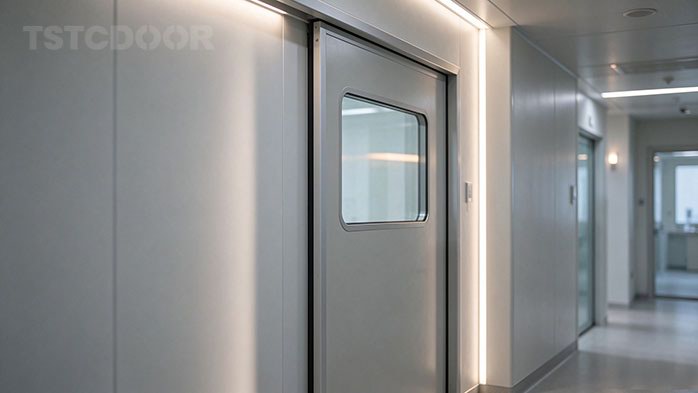
The doors to operating theatres, ICUs, negative-pressure rooms, and laboratories are not primarily concerned with convenient passage. Their first task is "keeping air where it belongs". A hermetic door has a specific mechanism: as the leaf slides, it also lowers and presses inward, compressing the sealing gaskets around the perimeter and forming an airtight chamber. Between two doors, an interlock ensures that one cannot open until the other is closed ,treating air itself as something that must be strictly controlled.
For clinicians this is simply part of the workflow: beds in and out, instrument trolleys through, a sterilised space that stays uncontaminated. For families, the door is something else entirely. It is always closed. A red light is on. We sit on a plastic chair in the corridor and watch the clock.
And when the surgery ends, when the door opens and the bed comes out, the door becomes an ordinary object again, quiet, smooth, unobtrusive. Its best performance happens exactly at the moment when people are most anxious - by adding no noise and no resistance.
4.Telescopic and Folding Doors -Making Small Spaces Bigger
Small shops, convenience stores, neighbourhood retail, narrow passageways - these use telescopic sliding doors or folding doors. Several leaves stack and nest into one another as they open, occupying only a short stretch of wall.
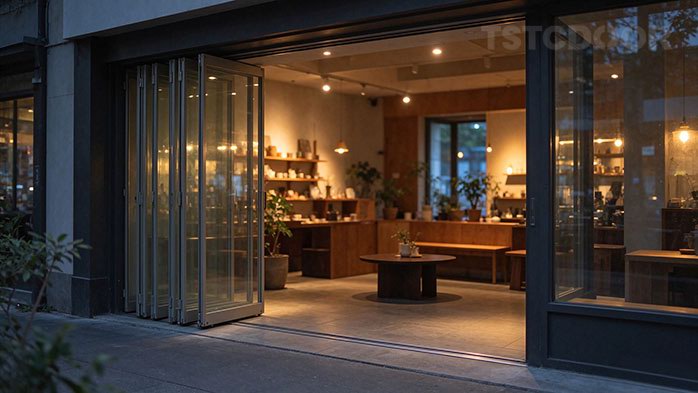
The point here is spatial economy: the opening can be wide, yet when the door is retracted it does not claim an entire wall. For a shop owner, that can mean half a metre more display frontage. For a passageway, it means crowds at peak times do not pile up in a bottleneck at the entrance.
5.Industrial Doors - Rarely Seen &Always Supporting
Hangar doors, sectional overhead doors, factory gates - most people see them only a few times a year. Yet the parcels we order, the goods on supermarket shelves, the cartons stacked in a courier depot all came out through doors like these. They do not shape the experience of daily life, but they determine whether the things daily life depends on arrive on time.
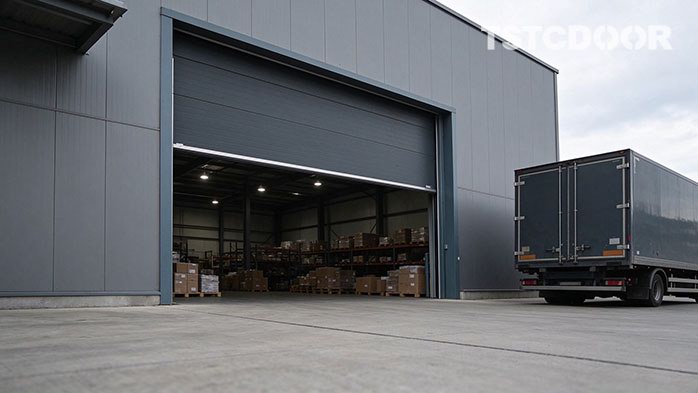
The Best Door Is the One We Never Notice
An automatic door looks like glass, aluminium profiles, and a motor. In practice it is a system of decisions: sensors decide "when to open", variable-frequency control decides "how fast to open and how slowly to close", safety sensors like anti-strike light curtains decide "when it must stop", backup power decides "whether it still works during an outage".
Much of that design is not about efficiency at all. It is about the people who move slowly, like the elderly, children, parents with strollers, wheelchair users, travellers loaded with bags. Two extra seconds of hold-open time costs an able-bodied person nothing,for someone who walks slowly, it is the difference between getting through and not.
An automatic door is passed through hundreds, sometimes thousands of times a day, and almost no one stops to wonder how it works. Only when it breaks, catches someone, closes too quickly or opens too slowly does anyone "see" it for the first time.
In that sense, the deepest connection between automatic doors and everyday life is not how advanced they are, it is how quietly they perform actions we never realise we depend on, like blocking wind, keeping out dust, saving effort, holding warmth, yielding the way, standing guard.
People never remember the automatic doors, they remember only the places they reached after passing through the doors .


Comments
Post a Comment